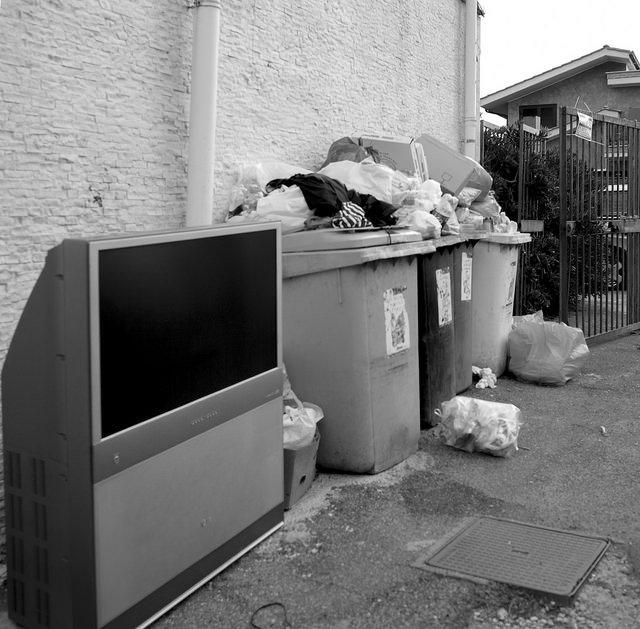
The last decade or so has seen a massive shift in the way we watch television. Flatscreens have effectively vanquished the old cathode ray tube (CRT) TVs, as well as other large and unwieldy sets. The image above is hardly a rare sight, as day by day more old boxes are sent to the ol’ curbside purgatory, replaced with sleeker and more stunning new screens.
But where do all those old TVs end up? From 1980 until whenever they stopped producing them, 705 million CRT TVS were sold in the U.S. alone. It’s likely less than a third of them are still being used. That ends up leading to a whole lot of plastic, glass, and lead in landfills.
I was at a garage sale recently where a couple of nice CRT TVs (and a huge projection set), still fully functioning, were on sale for as little as $10. There were no takers, not even for a basement screen or a spare in case the regular breaks down. Sure, they’re outdated, but there’s also a stigma attached to old TVs; owning one seems to be about as uncool as frosted tips or bell bottoms. They’re of a bygone era and we’re in one that can’t wait to reach the next.
So, as with any other artifact or arcane technology, the old tubes will just collect dust for the next thousand years until some future human digs them up and marvels at the past’s puerile and primitive tech capabilities.
Photo credit: Marsel Minga / Flickr