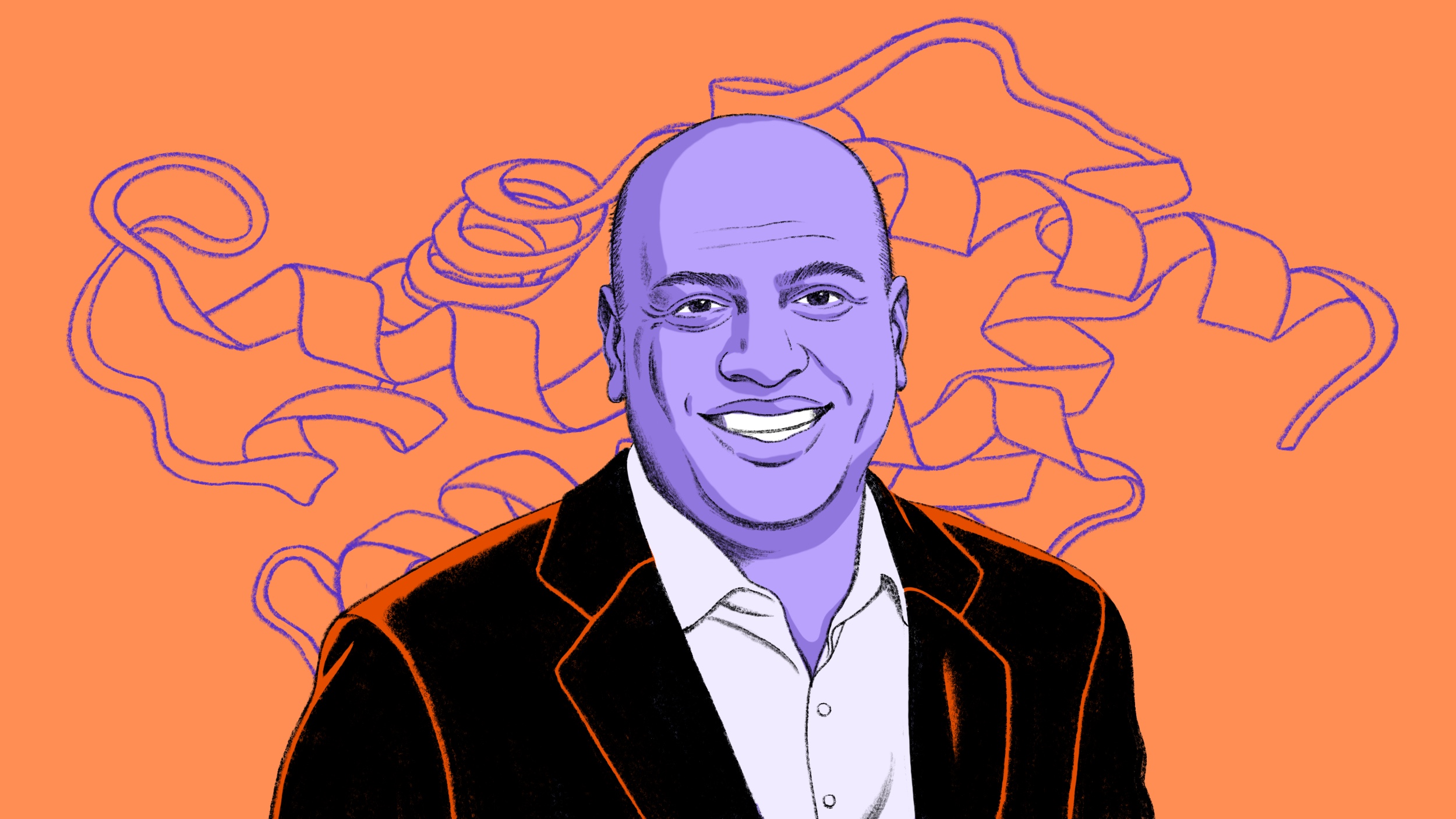
Wikipedia visionary Jimmy Wales wants innovators to have fun. Seriously

- English Wikipedia is now roughly 93 times bigger than Encyclopedia Britannica.
- Wales on polarization: “The general public longs for neutrality in media in a really deep way.”
- “You have to find people you can trust,” says Wales, “and lead in such a way that they can trust you.”

Jimmy Donal Wales (born August 7, 1966), also known as Jimbo Wales, is an American internet entrepreneur and former financial trader.
That opening sentence was lifted wholesale from Wikipedia, the revolutionary online encyclopedia that elevated Wales into cultural legend. As he details in his new book The Seven Rules of Trust: A Blueprint for Building Things That Last, the ascent was anything but smooth.
Wikipedia launched on January 15, 2001, and by 2006 was being roundly mocked on The Colbert Report as a disinformation train primed for derailment by the meddling demons of human nature — but the “pathological optimist” in Wales refused to concede that his venture, and by extension the entire concept, was doomed.
His instincts were, to say the least, solid. The English Wikipedia is now roughly 93 times bigger than Encyclopædia Britannica, the shelf-warping print leviathan that fascinated him as a child.
“The sunny, pro-social view of human nature that inspired Wikipedia may be out of fashion in these cynical times,” he writes in his book. “But I will insist that it is correct.”
Given that Big Think shares his belief that our fragmented current media can offer way more than its default maelstrom of antagonism, we were eager to chat with Wales about our common interests: the virtues of neutrality, the possible transformations of social media, antidotes to toxicity, the potential of AI, and much more.
Big Think: You have described yourself as a “pathological optimist” — would you say that is your most defining attribute as an innovator?
Jimmy Wales: I suppose it is my most defining attribute — it’s certainly a big part of my identity and how I relate to the world. I think that in order to make progress, in order to innovate, you have to operate with a fundamental “benevolent universe” premise — that it is actually possible to succeed. Of course, the reason I say “pathological” is that I know I can have blind spots about problems, because I tend to think everything is ok, so I do like to work with a team of people including a few who are good at worrying more than I do!
Big Think: Do we have to practice trust — exercise it like a muscle — to ensure humanity is more trusting than cruel?
Jimmy Wales: Yes, although I’m not sure I really like the “like a muscle” analogy in this context. Basically, we have to choose trust for rational reasons — both that it is a good bet and that trust begets trust, and as a society we need to build a culture where trust matters. In a sense that’s like a muscle, but muscles don’t choose — the human mind chooses.
You can’t build a successful organization on a swampy ground of mistrust.
Big Think: Which historical business visionaries, in your view, best understood the value of trust?
Jimmy Wales: Interestingly, I think a great many of them did and do. You can’t build a successful organization on a swampy ground of mistrust. You have to find people you can trust, and lead in such a way that they can trust you. This doesn’t mean people have to be perfect all the time — I know I’m not. It’s more the assurance that you’ll mean what you say, and do what you should do.
Big Think: Here at Big Think, we strive to be “curious, thoughtful, open, and constructive.” Is there anything we’re missing?
Jimmy Wales: I think that’s a nice summary of a great attitude. For me, the pillar that speaks most strongly there, because I believe it is the foundation of the others, is to be “thoughtful.” The overwhelming need in order to succeed intellectually and in every other sense is to focus one’s mind and… think.
Big Think: Is neutrality due for a comeback — or is the tide of media technology sweeping us inexorably towards partisanship?
Jimmy Wales: I think the general public longs for neutrality in media in a really deep way. Right now I think a very short-sighted look at “engagement metrics” is misleading a lot of media outlets into an unsustainable destruction of their long-term brand value. Yes, a screaming rant with flaming headlines may get you more clicks today — but if you’re reducing people’s sense that you are there to bring them clear factual information, you become extremely vulnerable to disruption.

To sound a note of optimism and suggest a way out of the social media fever swamp, you [can] cite [Franklin D.] Roosevelt. “It is common sense to take a method and try it. If it fails, admit it frankly and try another. But above all, try something.”
Big Think: What experimental approach to social media are you currently most excited about?
Jimmy Wales: I have a pilot project with just a few people working on it, and we’re exploring a system where posts can be prioritized in your feed not based on engagement or virality, but based on the judgments of the most trusted members of the community. It isn’t something I have been heavily promoting, because it’s very much a work in progress and I want to try to get it right. But people can certainly check it out at https://trustcafe.io/
Big Think: What possible innovation based on AI makes you most excited?
Jimmy Wales: I’m pretty excited by all of it. Of course we all know the amazing results and potential benefits and hazards of large language models. But I think a lot of people in the general public haven’t really focused on the astonishing progress that’s taking place in science. My friend Demis Hassabis of DeepMind just recently won the Nobel Prize in Chemistry for the work he and his team at DeepMind did on AlphaFold, a real breakthrough in the biology of proteins. That is going to save millions of lives in the coming decade, and improve the quality of life for millions more. It can’t be ignored.
Big Think: And what application of AI seems to you more likely to hit a dead end?
Jimmy Wales: I think it’s too early to tell. It seems clear, lately, that large language models have at least temporarily hit a wall in terms of scaling. For a while, it seemed that throwing more compute at more data was resulting in both steady and strong improvements. But the latest versions of improved models have been incrementally better at best. It seems that a further set of breakthroughs is needed, and I see a lot of excitement and experimentation in the open source world around that. But it’s too early to call it as a “dead-end”!
A good thing that a lot of people can do is abandon the places online that aren’t benefitting you.
Big Think: Is there anything to be said for the auteur theory of innovation, or are the days of the lone genius well and truly over?
Jimmy Wales: I think it’s about as true or untrue as it has ever been. It’s important not to dismiss the lone efforts of the sole genius in moving things forward, but the breakthrough “a ha” is actually often a relatively small thing that builds on a lot of near-misses and work to get to that point.
Big Think: What’s something simple we can do to persuade more people to lean into Wikipedia’s maxim “assume good faith” and turn toxicity into civility?
Jimmy Wales: What I like to do is remind people how they treat each other in real life, and how people treat them. Most people find that most people are basically perfectly nice people. It’s mainly the online world and worlds of politics and culture wars that have turned toxic.
As for me, one of the best things I did for my own happiness and goodwill towards humanity was to remove my twitter/X login from my phone. I would cancel it entirely except that it does serve for now as a useful broadcast channel, and I have a few friends on there I don’t want to lose touch with. Other than that, a good thing that a lot of people can do is abandon the places online that aren’t benefiting you.
Big Think: What core leadership qualities do aspiring innovators need to make the next “crazy idea” a reality, when the percentages tell us that failure is the most likely outcome?
Jimmy Wales: Have fun. Seriously: Have fun. That way, even if it doesn’t work out, you had a great time trying, and you’ll be open to the next thing that comes along as well.