Every era believes it is enlightened. Old books teach us otherwise.

- It can be challenging to find the time and motivation to read old, classic books.
- Such books are uniquely valuable in helping us better understand ourselves and the modern world.
- To read more classic books, don’t treat them like an obligation; wait until a specific book or author calls you.
Imagine you’re shopping for your next read. You scan the bookstore shelves, registering the promising titles and colorful covers as you go. Among them are several older classics you promised yourself you’d read one day, and you feel a familiar pang of guilt over having not picked them up yet. Is today the day? No, you decide, and opt for a newer book that is currently trending on social media.
Sound familiar? It’s a typical dilemma among readers, and one that makes sense. Readers understandably want to read books that explore today’s pressing issues, keep their knowledge fresh, and support the living writers whose works they enjoy — all of which require reading contemporary books. And with more than a quarter of a million books published each year, in the U.S. alone, it can be challenging to find the time — to say nothing of the determination — to revisit those titles that have been gathering cultural dust for decades, maybe centuries.
I get that, yet I still want to make the case that reading older books — particularly those laureled as classics or part of the literary canon — is a valuable practice that every reader should make time for. These works are often not only wonderful reads in their own right but also provide unique opportunities for modern readers — opportunities newer books may not.

Read old books understand others better
One barrier to reading older books is the belief that they have grown stale. To live your daily life, you don’t need to know anything about medieval Chinese warfare, Romantic poetry, or the myths of people who honestly thought a giant serpent encircled the world.
Even so, older books still offer valuable insights into the universal qualities that make us human. Our beliefs and collective knowledge may have evolved, yet the life struggles we face, the existential questions we ask, and the ethical challenges we contend with are all reflected in the writings of generations long past.
Aristotle, Spinoza, and Descartes puzzled over problems that still stump philosophers. Thomas Paine and Karl Marx continue to shape how we view politics, social hierarchies, and human rights. And while few still trust that fate is literally written in the stars, we still look to the skies for answers to nature’s great mysteries.
In literature, the stories and themes that captivated readers centuries ago haven’t lost their resonance either. The pride of Odysseus, the passion of Shakespeare’s lovers, and the dread facing Ivan Ilyich on his deathbed remain inextinguishable qualities of our inner lives.
Reading older books allows us to engage in this historic cosmopolitanism, exploring our shared humanity not just across cultures but also eras.
Of course, you’ll encounter ideas and traditions that are obsolete — even ignorant and offensive. That’s okay, even preferable. As the critic Michael Dirda writes for the Washington Post, read them anyway. Recognizing the mistakes, prejudices, and inhumane practices of humanity’s shared past, he points out, isn’t the same as condoning them.
“What matters is acquiring knowledge, broadening mental horizons, viewing the world through eyes other than your own,” Dirda writes. “The great books are great because they speak to us, generation after generation. They are things of beauty, joys forever.”
Read old books to reexamine the modern world
Even with that mindset, it can be challenging sometimes to not judge the ideas found in old books. A few examples: Herodotus wrote that fox-sized ants dug up gold in the Indian deserts. The warrior ethos of The Iliad is out-of-date in our age of human rights, as is the natural philosophy of Aristotle. At best, such ideas come across as quaint; at worst, dangerous or plain wrongheaded.
However, it is important to remember that the authors of these books were shaped by the collective knowledge of their eras. They were unable to see their biases and cultural constraints, which seem clear to us thanks to the distance of history.
We also need to recognize that we are not immune to biases and false beliefs ourselves, and these mental shortcuts can hinder our ability to perceive the world as it is. While old books won’t cure us of these, they can help us better reflect on our limitations by immersing us in past cultures.
Jeffery Brenzel, former lecturer in the department of humanities at Yale University, calls this the “value of strangeness.” He likens reading old books to traveling abroad. After experiencing another culture, many tourists return home and see their own differently. They open their mind to the assumptions they held and learn to reconsider them more thoughtfully. Old books allow us to be temporal tourists.
C.S. Lewis made a similar point in his introduction to Saint Athanasius’ On the Incarnation: “People were no cleverer then than they are now; they made as many mistakes as we. But not the same mistakes. They will not flatter us in the errors we are already committing; and their own errors, being now open and palpable, will not endanger us.”
He continues: “Two heads are better than one, not because either is infallible, but because they are unlikely to go wrong in the same direction. To be sure, the books of the future would be just as good a corrective as the books of the past, but unfortunately we cannot get at them.”
Read old books to join the great conversations
Lewis goes on to say that only reading modern books is like trying to join a conversation halfway through. Yes, you may do a passable job keeping up, but you will have a much better command if you enter the conversation as early as possible. Older books preserve these conversational threads, allowing us to do just that.
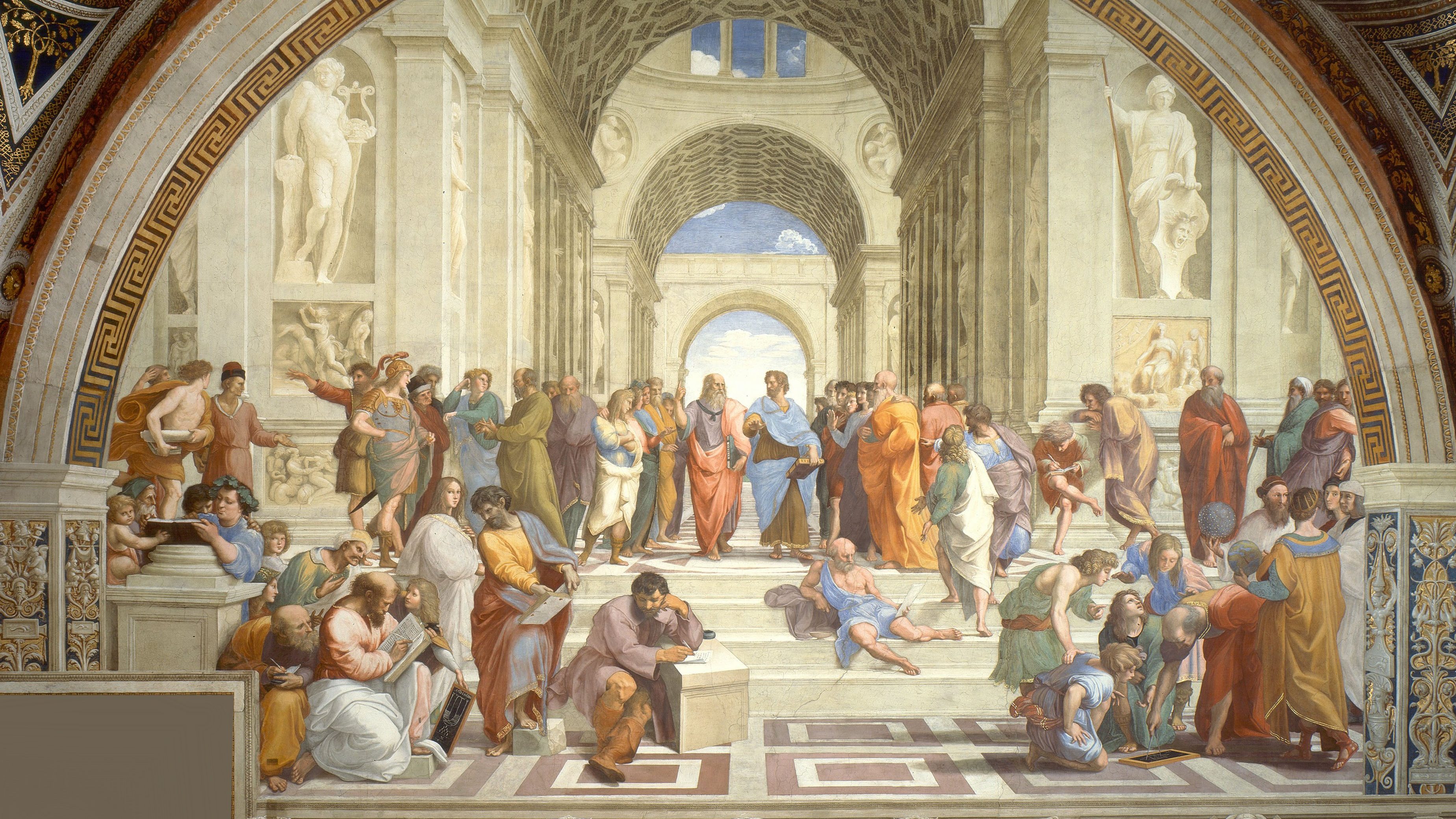
The philosopher Alfred North Whitehead likely had something similar in mind when he wrote: “The safest general characterization of European philosophical tradition is that it consists of a series of footnotes to Plato.” Brenzel puts it a little more straightforward:
“You simply cannot study the history of Western thought without running into Plato and Socrates around every corner. You can’t read a thinker who hasn’t been influenced by these ideas in some way as well as the way that they actually posed the original questions.”
Brenzel asks us to look at Christianity as an example. Many assume that modern Christian views come straight from the Bible, and some do, but Christianity is also part of an intellectual conversation that took place across the Mediterranean world.
Greek culture heavily influenced the Apostle Paul. Together, Paul and Plato would prove an indelible influence on St. Augustine. Augustine’s views would go on to influence Thomas Aquinas, who (along with Virgil) would influence Dante Alighieri, who would influence John Milton, who would influence how the English-speaking world has read and interpreted the Bible ever since.
Today, Christian views on everything from the afterlife to the cosmic struggle of good and evil would be quite foreign to a pre-Pauline Christian, and that’s because of where the conversation has taken the tradition in the intervening centuries.

Read old books because they call to you
All these motivations are ultimately meaningless if you don’t find reading old books gratifying. Otherwise, why bother pulling one off the shelf?
Luckily, my final reason to read old books is that they can be enjoyable experiences. They can also be inspiring, terrifying, rewarding, challenging, exhilarating, and provocative. They don’t simply hand down prepackaged knowledge but ignite within us the full spectrum of human emotions.
But none of that is possible if we approach them as the mental equivalent of folding the laundry.
For the record: This chore-like approach isn’t some new phenomenon bred in a patience-deprived generation raised on TikTok and two-day shipping. As Mark Twain once quipped: “A classic is something that everybody wants to have read and nobody wants to read.” A sad irony, then, that Twain’s many fantastic books now exist on many people’s literary chore lists.
To shift this mindset, we shouldn’t approach older books the way we did in school. These aren’t burdens you need to bear to become educated or cultured or pass some secret life exam. There will be no report card. Instead, wait until a particular book calls to you. If you’re not ready for the dialogues of Plato, try the plays of William Shakespeare or the Romantic poetry of John Keats. If none of those speaks to you, the Victorian era has some fantastic mysteries and ghost stories to get lost in.
Humanity’s collective library is vast, more than anyone can read in a lifetime. You’ll find something that will entice you. All you have to do is look.
What’s old is new again
Returning to our imaginary shopping trip, you shouldn’t feel guilty when you pass over older books in favor of something more recent. Those current events, pressing issues, and living artists need our attention, too. A good rule of thumb, one I borrow from Lewis, is to try to make every third or fifth read a classic or older book.
And don’t feel rushed either. Author Italo Calvino once defined the classics as: “[T]hose books which constitute a treasured experience for those who have read and loved them; they remain just as rich an experience for those who reserve the chance to read them for when they are in the best condition to enjoy them.”
These books have already waited a long time to reach your nightstand. What’s a few more months or even years? Just as long as we give them a fair chance and are receptive to what they have to say when that time finally arrives to give them a read.