Search
Jason Gots
Editor/Creative Producer, Big Think
Jason Gots is a New York-based writer, editor, and podcast producer. For Big Think, he writes (and sometimes illustrates) the blog "Overthinking Everything with Jason Gots" and is the creator and host of the "Think Again" podcast. In previous lives, Jason worked at Random House Children's Books, taught reading and writing to middle schoolers and community college students, co-founded a theatre company (Rorschach, in Washington, D.C.), and wrote roughly two dozen picture books for kids learning English in Seoul, South Korea. He is also the proud father of an incredibly talkative and crafty little kid.
Read Less

Internet pioneer Jaron Lanier argues that free technologies like Facebook come with a hidden and heavy cost – the livelihoods of their consumers.

While researching creativity for his book Imagine: How Creativity Works, Jonah Lehrer spent some time at 3M, analyzing the company culture that earned it the title of third most innovative company in the world in a recent survey of executives.

The Mind/Body Split in American Acting (and culture) On the whole, and with a few notable exceptions, Hollywood expects its great actors to play themselves in every role. We want […]

By consciously practicing optimism, Jason Silva believes, we create circumstances that make external challenges weaker and easier to overcome. It’s mind over matter – thinking your ideal world into being by choosing to believe it already exists.

Rather than being afraid of our new publicness, says Jarvis, we ought to use it to solve some of our most complex problems.

The reassuring point of Jonah Lehrer’s new book is that neuroscientific research into the human imagination will enable us to engineer environments that foster the creativity that is every human’s birthright, rather than extinguishing it.

Facebook and Twitter enable us to share ideas and discoveries with incredible speed and efficiency. At the same time, there’s a growing awareness that our identities in these virtual spaces are being constrained in ways we’re only beginning to understand.

As Silicon Valley startups race to develop the next generation of sophisticated, algorithmic marketing software, it’s instructive to note the success of Thinkmodo – a viral marketing firm that films all its videos on iphones, does no market testing, and doesn’t even mention the name of the product in its campaigns.

Clay Johnson, author of The Information Diet, says you can’t rely on “the media” or the internet to control your information consumption. Here he suggests a few pieces of software that have helped him to regulate his own information diet.

. . . figuring out what we want to do for a living is one of the most important and complicated decisions we make in our lives, and for many of us, school doesn't provide anything close to a road map.

In our increasingly complex world we can't afford to silo ourselves off in little online and offline subcultures.

Big Think is excited to announce Humanizing Technology, a virtual expo in partnership with Bing, whose goal is to identify new technologies that integrate themselves seamlessly into our lives, capitalize on our unique strengths, and amplify the best of human nature.

A subtle but undeniable shift has been taking place in American corporate management theory. Roughly, the change corresponds to psychology’s shift from punishment & reward focused Skinnerian behavioralism to a focus on human relationships and development.
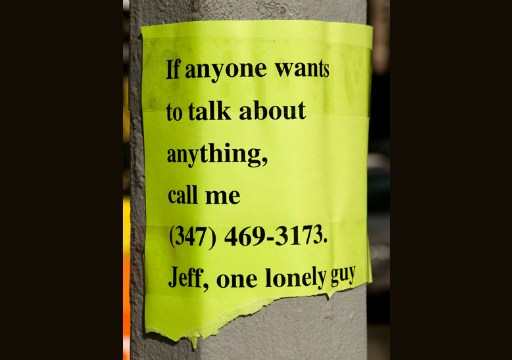
Last October, strangely personal fliers started appearing around New York City. They looked like this: When I first saw them, they really caught my attention. For some reason, I wasn’t […]
Relax, says Charles Duhigg, author of The Power of Habit. You can’t beat your Facebook addiction into submission – so schedule it into your work day.

It’s early days still for the neuroscience of meditation, but Kadam Morten, a teacher in the New Kadampa tradition of Buddhism, argues that the Buddha (Gautama Buddha, who lived in India approximately 2500 years ago) was the creator of a “science of the mind.”

Are shared human values possible and sustainable without religion? This is the subject of life philosopher Alain de Botton’s new book, Religion for Atheists.

While embracing controversy in any form is a challenging first step, Gloria Feldt – former CEO of Planned Parenthood – argues that women need to go further. She says women need to set the agenda – becoming political thermostats rather than thermometers.

The buzz surrounding physicist Stephen Hawking‘s newest experiments with communication technology has been a bit overexuberant, along the lines of “new technology could help Stephen Hawking communicate via brain waves!” […]

California-based TED is perhaps the most visible of the groups that are leading the crossover of serious intellectual thought into the pop mainstream. TED’s approach – the 18 minute inspirational […]